
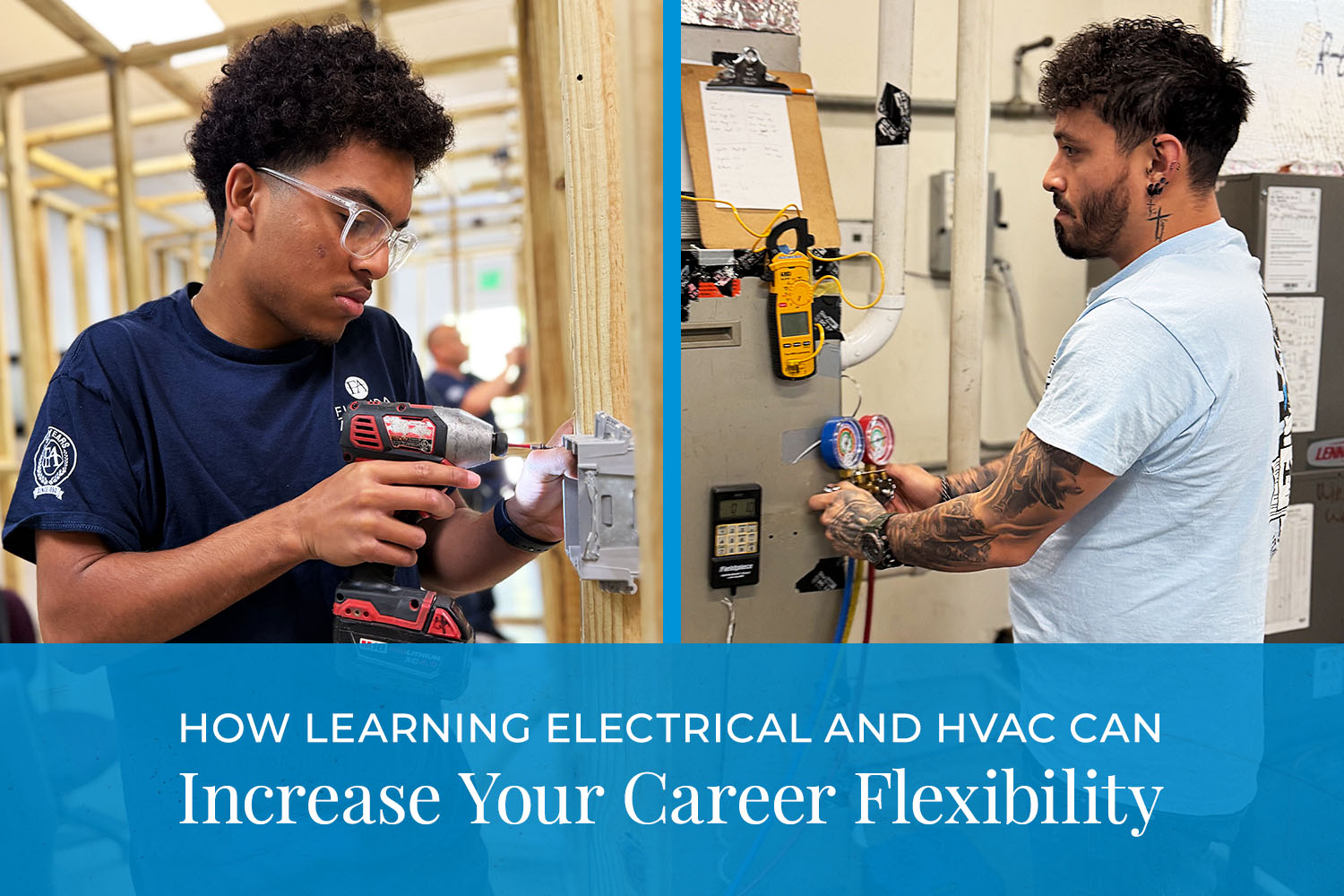
At Florida Academy, the Mechanical Construction Professional program is uniquely designed to address the changing demands of the workforce. Learning HVAC and electrical can increase your career flexibility because many heating, cooling, and refrigeration systems depend on electrical power, wiring, circuits, controls, and safe installation practices. As the only program in the region that offers this dual trades program, it provides a distinctive pathway for students seeking hands-on trade training. Building skills in both areas can help you understand how building systems work and prepare you for multiple job settings.
In the past, students often felt like they had to choose one path: HVAC/R or electrical. Today, those fields are closely connected. Air conditioning systems, heating units, refrigeration equipment, thermostats, motors, control boards, and smart building systems all rely on electrical components. By enrolling in the Mechanical Construction Professional program, students who understand both HVAC and electrical work may be better prepared to troubleshoot problems, work with different systems, and adapt as technology changes. For someone looking at trade school, this type of combined training is a strategic way to build a strong foundation.
For someone looking at trade school, this type of combined training can be a smart way to build a stronger foundation.
How Are HVAC and Electrical Work Connected?
HVAC systems do not operate on mechanical parts alone. Every residential split system, commercial rooftop unit, or refrigeration system needs electrical power to run. A technician may need to understand airflow, refrigerant, motors, wiring, voltage, safety procedures, and controls to properly evaluate what is happening with the equipment.
For example, if an air conditioning system stops working, the issue may not be the cooling system itself. It could be a failed capacitor, a burnt contactor, a faulty relay, a tripped breaker, a wiring issue, or a control board problem. Without electrical knowledge, it can be harder to know where the problem starts.
That is one reason HVAC and electrical training often overlap. Students who learn both areas can build a more complete understanding of how systems are powered, controlled, installed, and serviced.
Common HVAC components that involve electrical knowledge include:
- Compressor contactors and relays: Help control the power needed to start and operate equipment.
- Capacitors: Store and release electrical energy to support motors.
- Thermostats and low-voltage wiring: Send signals that tell the system when to heat, cool, or shut off.
- Control boards: Help manage communication between different system parts.
- Motors and fans: Depend on proper wiring and power to move air through the system.
- Circuit breakers and panels: Help protect electrical systems and equipment.
When students understand both the mechanical and electrical sides, they can see the full picture instead of only one part of the system.
Why Learn Both HVAC and Electrical Skills?
Learning both HVAC and electrical skills can give students more flexibility because the two trades support each other in real work environments. This does not mean every student will do every type of job. It means your training may help you understand more systems, ask better questions, and build confidence with a wider range of hands-on tasks.
1. Stronger Troubleshooting Skills
Troubleshooting is a major part of trade work. A system may look like it has one problem, but the actual cause may be somewhere else.
For example, if an HVAC unit will not turn on, the issue could be related to airflow, refrigerant pressure, the thermostat, a low-voltage connection, a motor, or the electrical panel. A student with training in both HVAC and electrical fundamentals may be better prepared to follow the problem step by step.
That may include learning how to:
- Use a digital multimeter
- Check voltage
- Understand continuity
- Read basic wiring diagrams
- Follow safety procedures
- Identify common electrical failures
- Understand how electrical parts affect heating and cooling performance
These are practical skills that can help students feel more prepared in the lab and later on the job.
2. Better Understanding of Modern Building Systems
Homes and businesses are becoming more connected. Many buildings now use smart thermostats, automated lighting, energy-efficient systems, sensors, control panels, and low-voltage communication lines. HVAC equipment is often part of that larger network.
Because of this, students who understand both HVAC and electrical concepts may be better prepared to work with modern systems. They can start to understand how power, controls, wiring, and equipment work together.
This matters in both residential and commercial environments. Whether someone is working in a home, apartment complex, office building, school, retail space, or service facility, the ability to understand connected systems can be valuable.
3. More Career Direction Options
One of the biggest reasons to consider combined training is flexibility. Students who study only one area may feel limited to one type of work. Students who build a foundation in both HVAC and electrical may have more room to explore different paths.
For example, training in both areas may support interest in:
- HVAC/R installation
- HVAC/R service and maintenance
- Electrical assistant work
- Facilities maintenance
- Building maintenance
- Commercial service environments
- Refrigeration-related work
- Residential trade work
- Light commercial systems
Career paths can vary based on licensing requirements, employer needs, location, and experience. However, having a broader foundation can help students understand more of the systems used in the field.
What Skills Do HVAC and Electrical Training Have in Common?
HVAC and electrical training share many hands-on skills. Both require safety awareness, attention to detail, problem-solving, and the ability to follow procedures.
Students may practice skills such as:
- Reading diagrams and schematics
- Measuring voltage, current, and resistance
- Understanding circuits
- Using hand tools and testing tools
- Following safety rules
- Troubleshooting equipment
- Working with motors, controls, and wiring
- Understanding how power moves through a system
- Identifying common system failures
- Practicing proper installation techniques
These shared skills can make combined HVAC and electrical training especially useful for students who enjoy hands-on work and want to understand how things operate.
Comparing HVAC, Electrical, and Combined Mechanical Construction Training
Students who are interested in trade school may compare several different training paths. Some programs focus mostly on HVAC/R. Others focus mostly on electrical. A combined Mechanical Construction Professional program brings both areas together into one structured training path.
| Training Focus | Standalone HVAC/R Program | Standalone Electrical Program | Combined Mechanical Construction Program |
| Main Area of Study | Heating, cooling, refrigeration, airflow, and refrigerant systems | Electrical theory, wiring, circuits, conduit, and safety | HVAC/R systems plus electrical power, wiring, and controls |
| Hands-On Lab Work | Recovery equipment, vacuum pumps, brazing, refrigerant tracking, system service | Bending raceways, mounting panels, wiring loads, and working with electrical tools | Wiring high- and low-voltage lines, working with HVAC/R equipment, practicing integrated system skills |
| Safety and Certification Preparation | May include preparation related to EPA Section 608 | May include OSHA safety practices and electrical safety | May include preparation related to EPA Section 608, OSHA safety practices, and electrical safety |
| Typical Program Length | Approximately 8 months | Approximately 8 months | Approximately 8 months |
| Best Fit For | Students focused mainly on heating, cooling, and refrigeration | Students focused mainly on electrical work | Students who want a broader foundation across HVAC/R and electrical systems |
This type of comparison can help students think about which path fits their goals, learning style, and career interests.
How Florida Academy Combines HVAC and Electrical Training
At Florida Academy in Fort Myers, the Mechanical Construction Professional program is designed to connect HVAC/R training with electrical training. Instead of treating the two areas as completely separate, the program helps students understand how they work together in real building systems.
Students do not only study from textbooks. They train in hands-on lab settings under the guidance of experienced instructors. The program gives students the opportunity to work with industry-standard equipment and practice skills connected to both HVAC/R and electrical systems.
Students may learn how to:
- Read electrical schematics
- Understand circuit loads
- Practice safety procedures
- Work with high-voltage and low-voltage systems
- Learn soldering, brazing, and gas-line black pipe assembly
- Practice residential and commercial troubleshooting
- Understand how electrical systems support heating, cooling, and refrigeration equipment
- Prepare for concepts related to the EPA Section 608 exam
- Build confidence using tools and equipment in a lab setting
This combined approach can help students build a more flexible foundation without having to complete two separate programs.
Is Combined HVAC and Electrical Training a Good Fit?
Combined training may be a good fit for students who like hands-on work, problem-solving, and learning how systems operate. It may also appeal to students who do not want to feel boxed into one narrow path too early.
This type of training may be worth considering if you:
- Like working with tools and equipment
- Want to understand how systems work
- Are interested in heating, cooling, electrical, or building maintenance
- Want hands-on training instead of a traditional classroom-only path
- Want to build skills that may apply in residential and commercial settings
- Prefer a program that connects more than one trade area
- Want a practical education that can help you explore different career directions
For many students, the value is not just learning two subjects. It is learning how those subjects connect on real job sites.
Frequently Asked Questions
Does HVAC training include electrical work?
HVAC training often includes some electrical concepts because heating, cooling, and refrigeration systems depend on power, wiring, motors, thermostats, relays, capacitors, and control boards. The amount of electrical training can vary by program. A combined program may go deeper by teaching both HVAC/R and electrical fundamentals in one curriculum.
Why is electrical knowledge important for HVAC work?
Electrical knowledge is important for HVAC work because many system problems are connected to power or controls. A technician may need to check wiring, measure voltage, test components, understand low-voltage thermostat signals, or read schematics to find the source of a problem.
What safety credentials are included?
Students in Florida Academy’s Mechanical Construction Professional program have the opportunity to earn a Florida Academy Diploma, an R410A Safety Certification, and an OSHA 10-Hour Survey Card. The coursework also includes theoretical and practical concepts that help prepare students for the EPA Section 608 exam, which is required for technicians who handle refrigerants.
Can this training apply to both residential and commercial settings?
Yes. The concepts taught in the classroom and lab can apply to both residential and commercial environments. Students may practice skills connected to home systems, standard electrical loads, commercial layouts, raceways, HVAC/R equipment, and troubleshooting procedures.
Does a combined program require twice as many years in school?
No. At Florida Academy, the Mechanical Construction Professional curriculum is designed to be completed in approximately 8 to 12 months. By focusing strictly on overlapping technical essentials, structural math laws (such as Ohm’s, Joule’s, and Kirchhoff’s laws), and hands-on workshop modules, the training is compressed into an efficient timeline.
Building a More Flexible Trade Skill Set
Learning HVAC and electrical can increase your career flexibility by helping you understand more of the systems used in today’s homes and businesses. HVAC/R equipment depends on electrical power, wiring, motors, circuits, controls, and safety procedures. When students learn how these areas connect, they can build a stronger foundation for hands-on trade work.
For students who want options, combined training can be a practical path. It can help you prepare for different job settings, understand modern building systems, and develop confidence in both mechanical and electrical concepts.
Florida Academy’s Mechanical Construction Professional program gives students a structured way to study HVAC/R and electrical systems together. To view our training labs, speak with an admissions representative about scheduling a tour, or review enrollment dates, contact us today and explore our technical programs today.