
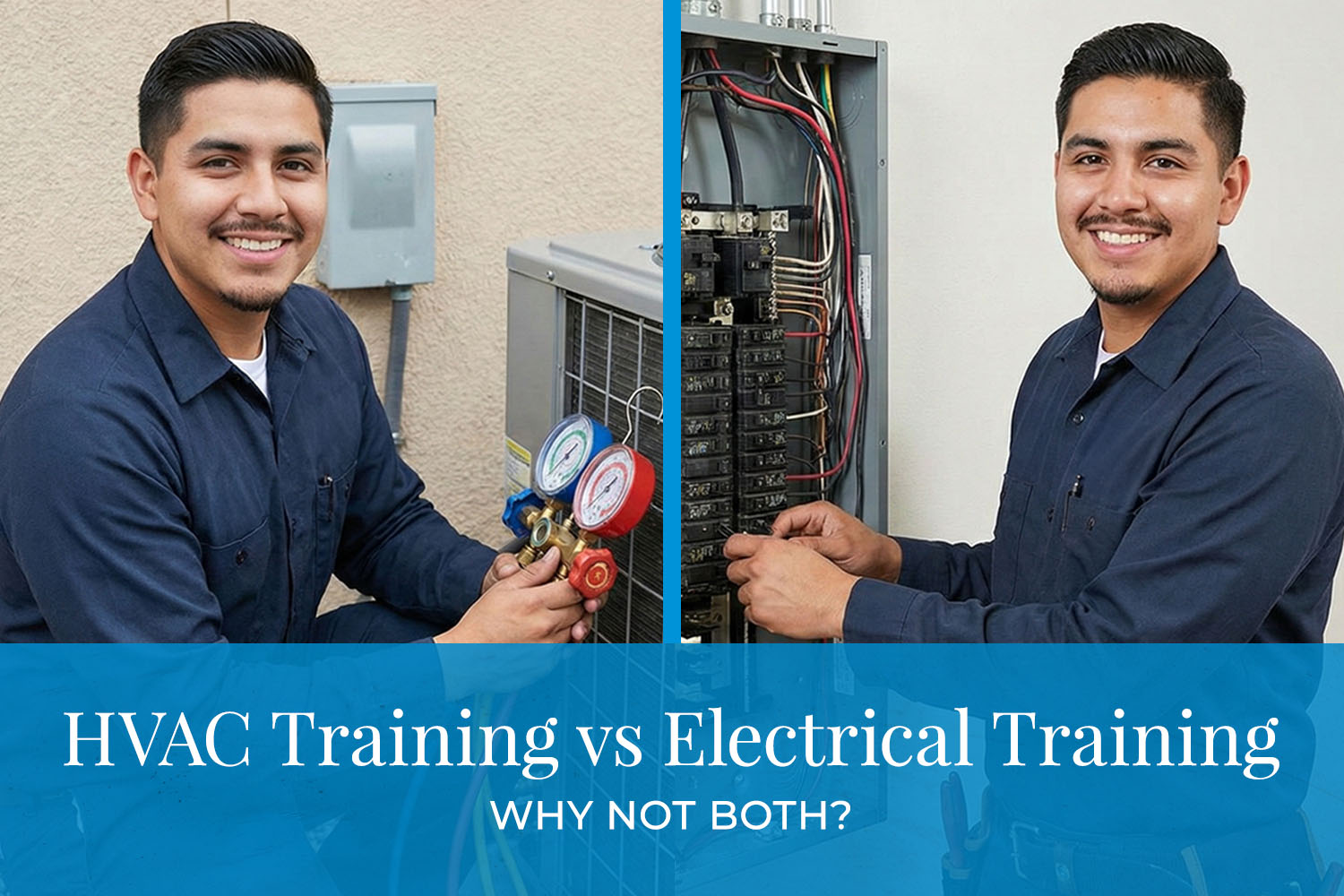
HVAC Training vs Electrical Training: Why Not Both?
by
If you are interested in a career that keeps modern infrastructure running, you have likely looked into specialized trade schools. Often, students feel they have to choose a single path, but when considering HVAC Training vs Electrical Training, it becomes a compelling question. At Florida Academy, our Mechanical Construction Professional program is designed to provide students with the opportunity to develop the foundational skills intended for entry-level roles in both of these vital industries simultaneously.
Defining the Role of a Mechanical Professional
In the professional trades, a mechanical contractor is a specialist responsible for the systems that allow buildings to function safely and efficiently. While many people associate this field solely with heating and cooling, the role is much broader. These professionals oversee the installation, maintenance, and repair of complex systems, including HVAC, refrigeration, and the electrical wiring that powers them.
The Skills of a Dual-Trade Professional
To understand the value of combined training, it is helpful to look at the specific technical areas where these fields overlap. When students weigh the benefits of HVAC Training vs Electrical Training, they find that our curriculum bridges the gap between different mechanical disciplines:
- HVAC and Refrigeration Systems: Gaining a strong foundation in heating and cooling cycles, control systems, and troubleshooting mechanical issues.
- Electrical Systems: Learning to install and connect commercial and residential wiring, raceways, and control devices.
- Theory and Code: Understanding electrical theory (such as Ohm’s and Kirchhoff’s laws) and learning to apply the National Electrical Code (NEC).
- Safety and Certification: Preparing for industry-standard credentials, including EPA Section 608 for safe refrigerant handling.
Program Details at a Glance
The journey to becoming a professional in this field begins with specialized education. Many question HVAC Training vs Electrical Training – why not both? Florida Academy’s mechanical construction program emphasizes training for both trades through lab-based exercises that simulate actual job sites.
| Feature | Details |
| Duration | In as little as 8-12 months |
| Learning Style | Mix of classroom and hands-on lab application |
| Focus | Installation, maintenance, and repair of HVAC and electrical systems |
| Credentials | Diploma and preparation for EPA and OSHA certifications |
Compliance and Career Expectations
Florida Academy is a licensed postsecondary school nationally accredited by the Council on Occupational Education (COE).
- Entry-Level Preparation: Our program is designed to prepare graduates for entry-level employment. Training provides the foundational “skillset” intended for the industry, but individual success depends on personal effort and the requirements of specific employers.
- Certification Requirements: While our program prepares you for certifications like the EPA Section 608, these credentials require passing a separate proctored exam.
- Licensure: This program provides vocational training; it does not grant a state contractor’s license, which typically requires years of field experience and additional state testing.
Frequently Asked Questions (FAQ)
Q: What certifications can I earn at Florida Academy?
A: Graduates have the opportunity to earn a Florida Academy Diploma, R410A Safety Certification, and an OSHA 10-hour Survey Card, while also receiving the preparation intended for the EPA Section 608 exam.
Q: Can I work in both residential and commercial settings?
A: The program curriculum is designed to provide the technical foundation used in both residential and commercial settings. Students learn to work on standard residential loads as well as the complex raceways often found in commercial electrical systems.
Q: What is the “two-in-one” career advantage of this program?
A: Unlike many single-trade programs, this curriculum provides a dual-focused education in both HVAC and Electrical systems. This “two-in-one” approach is designed to provide a dual-focused education intended to help graduates develop a versatile skillset. This approach allows students to pursue entry-level opportunities as either HVAC technicians or electrical installers or work for mechanical contractors who utilize both disciplines.
Ready to Start Your Journey?
Now that you have a better understanding of HVAC Training vs Electrical Training, why not do both? Florida Academy’s Mechanical Construction Professional program is a unique “two-in-one” training opportunity because it simultaneously prepares students for entry-level roles in both the HVAC and Electrical career fields.